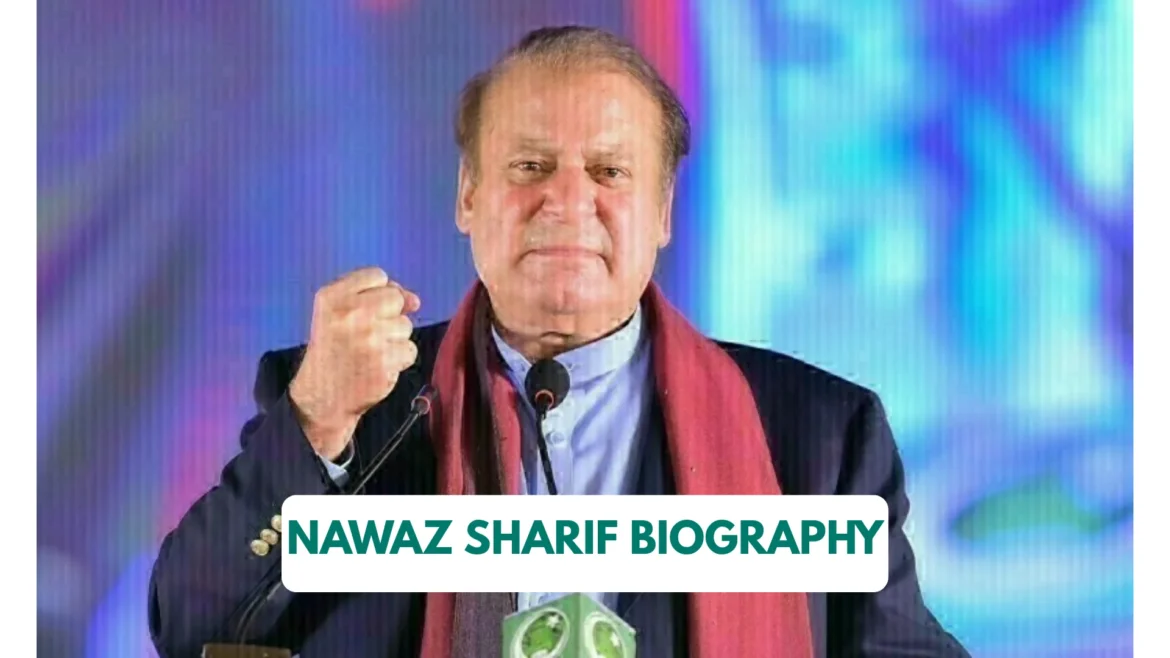
Nawaz Sharif is one of the most influential and controversial political figures in Pakistan’s history. Born into a wealthy business family in Lahore, he rose through provincial politics to become Prime Minister — not once, but three times.
Over decades, his career has been shaped by economic ambitions, infrastructure projects, political clashes, and legal battles. In this post, we dive deep into his life story — from early years to premiership, controversies, and enduring legacy.
Early Life & Background
Nawaz Sharif was born on 25 December 1949 in Lahore, Punjab, Pakistan. He hailed from a wealthy Kashmiri-origin industrialist family: his father, Muhammad Sharif, founded the family business conglomerates that invested in steel, textiles, and other industries.
For his education, Nawaz attended Government College University in Lahore for his undergraduate studies and later earned an LL.B. (law degree) from the University of the Punjab.
His early exposure to business and law likely shaped his pragmatic, business-friendly approach when he eventually entered politics.
Entry into Politics
Nawaz Sharif’s political journey began after the nationalization of private industry in Pakistan under the then-government of Zulfikar Ali Bhutto. This affected his family’s industrial holdings, prompting his shift toward politics.
Under the patronage of then-military ruler Zia-ul-Haq, Sharif was appointed Provincial Finance Minister of Punjab in 1981. By 1985, he had climbed further to become Chief Minister of Punjab — a powerful and strategic provincial role.
During this time, Sharif built his political base in Punjab, leveraging both his business acumen and political alliances.
Rise to National Leadership — First Terms
First Term as Prime Minister (1990–1993)
In 1990, following the withdrawal of support from then-prime minister Benazir Bhutto by the President, Sharif came to power as Pakistan’s Prime Minister.
During this first term, Sharif initiated a program of economic reforms and privatization of state-owned enterprises — a move aimed at liberalizing the economy and boosting growth.
However, his first premiership ended in 1993 when he was dismissed by the president under constitutional powers that allowed removal of governments deemed inefficient or corrupt.
Second Term as Prime Minister (1997–1999)
Sharif made a political comeback in 1997, winning a landslide victory to again become Prime Minister.
In this second tenure, he took bold steps — notably the removal of a constitutional clause that allowed presidents to dismiss elected governments, thereby strengthening the parliamentary system.
But the tension between his government, judiciary and the military escalated. A constitutional crisis erupted when Sharif attempted to block the appointment of additional Supreme Court judges — a move that antagonized Pakistan’s power centers.
The crisis culminated in a military coup in 1999 by General Pervez Musharraf. Sharif was deposed, tried in a military court on charges including hijacking and terrorism, and sentenced to life imprisonment.
In 2000, he was allowed to go into self-exile — leaving behind his political career in Pakistan for the time being.
Return & Third Term (2013–2017)
After years in exile, Sharif was cleared to return to Pakistan in 2007 when the judiciary ruled he had the right to re-enter the country.
His party, Pakistan Muslim League (N), regained strength, and in the 2013 elections, Sharif won a third term as Prime Minister — becoming the longest-serving PM in Pakistan’s history with more than nine years in total across his three tenures.
Sharif’s third tenure focused on what he described as the “three E’s”: economy, energy, and extremism.
Significant efforts were made to stabilize the economy, attract foreign investment, and implement infrastructure projects. One of his administration’s flagship initiatives involved cooperation under the China–Pakistan Economic Corridor (CPEC), which entailed major investments, infrastructure developments and promised economic growth (though critics cite rising debt burdens as a downside).
Sharif also attempted to navigate foreign policy — pushing for improved relations with neighboring countries, seeking resolution of longstanding issues such as Kashmir, and expressing a desire for regional stability.
At home, Pakistan faced a gamut of challenges: energy shortages, frequent electricity blackouts, and a fragile security environment amid rising extremist violence. These problems, combined with political pressure and public discontent, tested Sharif’s leadership.
Controversies, Legal Battles & Disqualification
Despite his political successes, Sharif’s career has been marred by serious allegations over corruption, misuse of power, and hidden assets — accusations that particularly surfaced after the 2016 leak of the Panama Papers, which implicated his family in offshore real estate deals abroad.
In July 2017, the Supreme Court ruled unanimously to disqualify Sharif from holding public office, thereby ending his third term prematurely.
He, along with his family members, faced multiple cases — resulting in convictions and sentences in absentia for owning assets beyond declared income. In 2018 he was convicted and sentenced to prison.
Critics have pointed to persistent allegations of corruption, claiming that many of his business interests and policies benefited his family’s wealth — a recurring theme in debates about dynastic politics in Pakistan.
Supporters — however — argue that much of the legal action was politically motivated and aimed at undermining his party’s influence.
Legacy & Impact
Nawaz Sharif’s political career is emblematic of Pakistan’s complicated interplay between democracy, military influence, judiciary activism, and corruption allegations. Some of his lasting impacts include:
- Pushing for privatization and economic liberalization in the 1990s, transforming Pakistan’s economic landscape.
- Launching key infrastructure projects and championing foreign investment, especially under the CPEC framework.
- Attempting constitutional reforms to strengthen parliamentary democracy and reduce presidential/military powers (especially during his second term).
- Elevating the role of his political party, PML-N, into a major power center — shaping Pakistan’s politics for decades.
- Being a symbol of political resilience: returning from exile, surviving dismissals, and staging multiple comebacks.
At the same time, his administrations have been criticized for not fully resolving Pakistan’s chronic problems — including energy shortages, inflation, security issues, and governance deficits. Corruption allegations and dynastic politics continue to haunt his legacy.
Frequently Asked Questions (FAQs)
Q: When was Nawaz Sharif born?
A: Nawaz Sharif was born on 25 December 1949 in Lahore, Punjab, Pakistan.
Q: How many times has Nawaz Sharif been Prime Minister?
A: He served as Prime Minister of Pakistan three times: 1990–1993, 1997–1999, and 2013–2017.
Q: Why was he removed from office in 2017?
A: He was disqualified by the Supreme Court following corruption allegations tied to the Panama Papers leak, which implicated his family’s offshore holdings.
Q: What is PML-N?
A: PML-N stands for Pakistan Muslim League (Nawaz), the political party led by Nawaz Sharif and his family. It has been one of the leading parties in Pakistan since the early 1990s.
Q: Is Nawaz Sharif Pakistan’s longest-serving Prime Minister?
A: Yes — cumulatively, across his three non-consecutive terms, he served more than nine years, making him the longest-serving Prime Minister in Pakistan’s history.
Conclusion
Nawaz Sharif’s story is one of ambition, resilience, controversy, and influence. From inheriting a wealthy business legacy to navigating the turbulent waters of Pakistani politics, his journey spans decades and reflects the broader struggles of a nation caught between democracy, military power, and institutional reform.
His contributions — especially in economic liberalization and infrastructure development — remain significant. Yet, the accusations of corruption, the repeated downfalls, and the dynastic nature of his party raise enduring questions about transparency, accountability, and the true cost of power.
Whether you view Nawaz Sharif as a reformer or a controversial elite, his role in shaping modern Pakistan is indisputable. As political dynamics evolve, his legacy — in infrastructure, law, governance, and controversy — will likely continue to influence Pakistan for years to come.