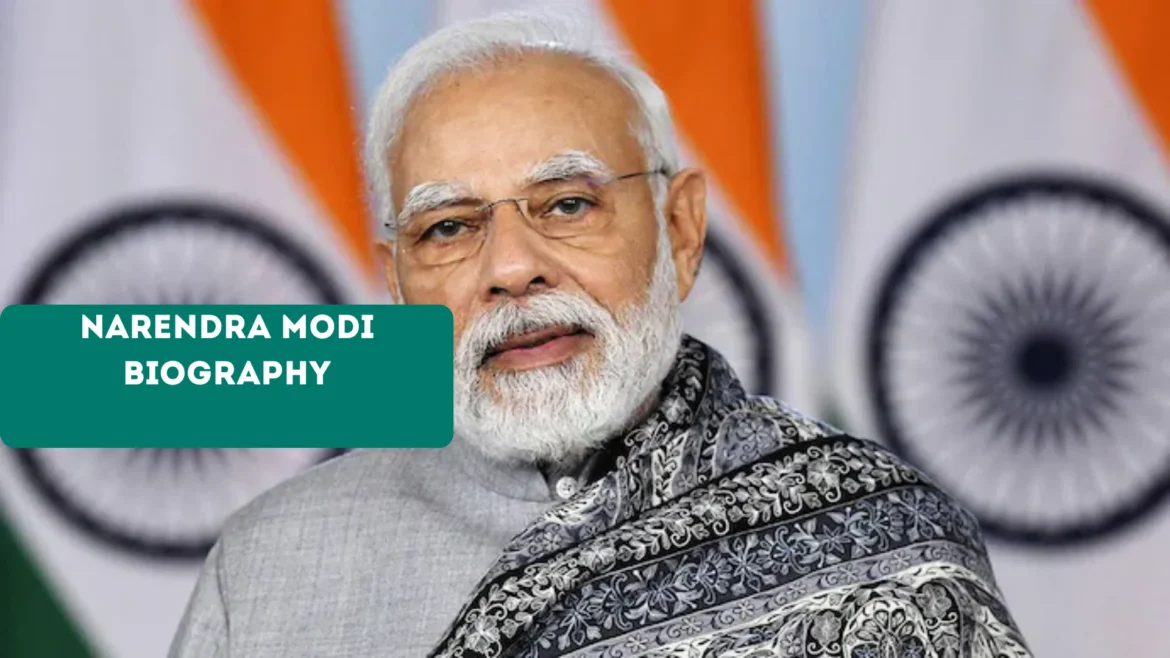
Narendra Modi is one of the most influential political leaders in contemporary Indian history.
Known for his charismatic leadership, strong nationalist ideology, and transformative governance agenda, Narendra Modi has reshaped Indian politics and governance since becoming the Prime Minister of India.
From humble beginnings to holding the highest executive office in the world’s largest democracy, his journey is both inspirational and controversial.
Early Life
Narendra Damodardas Modi was born on 17 September 1950 in Vadnagar, a small town in the Mehsana district of Gujarat, India. He was born into a modest family belonging to the Ghanchi community, classified as an Other Backward Class (OBC) in India.
His father, Damodardas Mulchand Modi, ran a tea stall at the local railway station, where young Narendra Modi often helped serve customers. This early exposure to hardship and discipline deeply influenced his worldview. His mother, Heeraben Modi, was known for her simplicity, spiritual nature, and strong moral values.
Education
Narendra Modi completed his schooling in Vadnagar, where he was considered an average student but highly active in debates, drama, and extracurricular activities. From a young age, he showed a keen interest in politics, history, and social service.
He later earned a Bachelor of Arts degree in Political Science from the University of Delhi through distance learning and subsequently completed a Master’s degree in Political Science from Gujarat University. During his youth, Modi was deeply influenced by Indian nationalist ideologies and leaders who emphasized discipline, service, and cultural pride.
Association with Rashtriya Swayamsevak Sangh (RSS)
One of the most defining aspects of Narendra Modi’s biography is his early association with the Rashtriya Swayamsevak Sangh (RSS). He joined the RSS as a pracharak (full-time worker) in his teenage years.
The RSS played a crucial role in shaping his ideological foundation, organizational skills, and leadership qualities. Through years of grassroots work, Modi gained extensive experience in mobilizing people, organizing campaigns, and managing large networks—skills that would later define his political success.
Entry into Politics and BJP Career
Narendra Modi formally entered mainstream politics through the Bharatiya Janata Party (BJP) in the 1980s. He quickly rose through the party ranks due to his organizational abilities and strategic thinking.
He played a significant role in strengthening the BJP’s presence in Gujarat and later at the national level. Modi was involved in key political movements and election strategies that helped the BJP expand its influence across India during the 1990s.
Chief Minister of Gujarat (2001–2014)
In 2001, Narendra Modi was appointed Chief Minister of Gujarat. His tenure, which lasted over 12 years, became a turning point in his political career.
Economic Development
As Chief Minister, Modi focused heavily on infrastructure development, industrial growth, and investment promotion. Gujarat witnessed significant improvements in roads, electricity supply, ports, and industrial zones. The “Vibrant Gujarat” summit attracted global investors and positioned the state as a business-friendly destination.
Governance Model
Modi promoted what came to be known as the “Gujarat Model of Development,” emphasizing efficiency, privatization, and minimal bureaucracy. Supporters praised the model for boosting economic growth, while critics argued that social indicators such as health and education did not improve equally for all communities.
Controversies
His tenure was also marked by the 2002 Gujarat riots, one of the most controversial events in modern Indian history. While courts later found insufficient evidence to prosecute him, the episode remains a significant point of criticism and debate in Narendra Modi’s biography.
Rise to National Leadership
By 2013, Narendra Modi emerged as the BJP’s prime ministerial candidate for the 2014 general elections. His campaign focused on development, corruption-free governance, nationalism, and strong leadership.
Using innovative digital campaigns, mass rallies, and a clear narrative of change, Modi connected with millions of voters, especially the youth. The BJP secured a historic majority in the 2014 elections, making Modi the Prime Minister of India.
Prime Minister of India (2014–Present)
Major Achievements
As Prime Minister, Narendra Modi launched several ambitious initiatives, including:
- Swachh Bharat Abhiyan: A nationwide cleanliness and sanitation campaign.
- Make in India: Encouraging domestic and foreign manufacturing.
- Digital India: Expanding digital infrastructure and online services.
- Jan Dhan Yojana: Financial inclusion for millions of unbanked citizens.
- Ayushman Bharat: A large-scale public health insurance scheme.
Economic Reforms
Key economic decisions such as the introduction of the Goods and Services Tax (GST) and the demonetization of high-value currency notes were aimed at formalizing the economy and reducing black money. These moves were praised for long-term vision but criticized for short-term economic disruption.
Foreign Policy and Global Image
Narendra Modi has significantly reshaped India’s foreign policy. He strengthened ties with major global powers, increased India’s presence on international platforms, and projected India as a rising global force.
His diplomatic style, large diaspora outreach, and emphasis on strategic partnerships enhanced India’s global visibility and influence.
Leadership Style and Ideology
Modi is known for his centralized leadership style, strong communication skills, and decisive governance. He emphasizes nationalism, cultural identity, and self-reliance, often using symbolic gestures and mass communication to connect with citizens.
Supporters see him as a transformative leader, while critics express concerns over democratic institutions, press freedom, and social harmony.
Personal Life
Narendra Modi leads a simple and disciplined personal life. He is known for his vegetarian diet, yoga practice, and minimalistic lifestyle. His life story—from a tea seller’s son to Prime Minister—is frequently cited as an example of determination and self-made success.
Legacy and Impact
Narendra Modi’s legacy is complex and multifaceted. He has undeniably transformed Indian politics, governance, and global perception. Whether viewed as a visionary reformer or a polarizing leader, his impact on India’s political landscape is profound and lasting.
FAQs
Q1. Who is Narendra Modi?
Narendra Modi is the Prime Minister of India and a senior leader of the Bharatiya Janata Party.
Q2. When was Narendra Modi born?
He was born on 17 September 1950.
Q3. What is Narendra Modi famous for?
He is known for his leadership, development-focused governance, and nationalist policies.
Q4. What was Narendra Modi before becoming Prime Minister?
He served as the Chief Minister of Gujarat from 2001 to 2014.
Q5. What is Narendra Modi’s educational background?
He holds a Master’s degree in Political Science.
Conclusion
The biography of Narendra Modi reflects a journey shaped by ambition, ideology, discipline, and controversy. From grassroots activism to national leadership, Modi’s rise symbolizes the changing dynamics of Indian politics. His policies, leadership style, and vision continue to influence India’s future and spark debate both domestically and internationally.