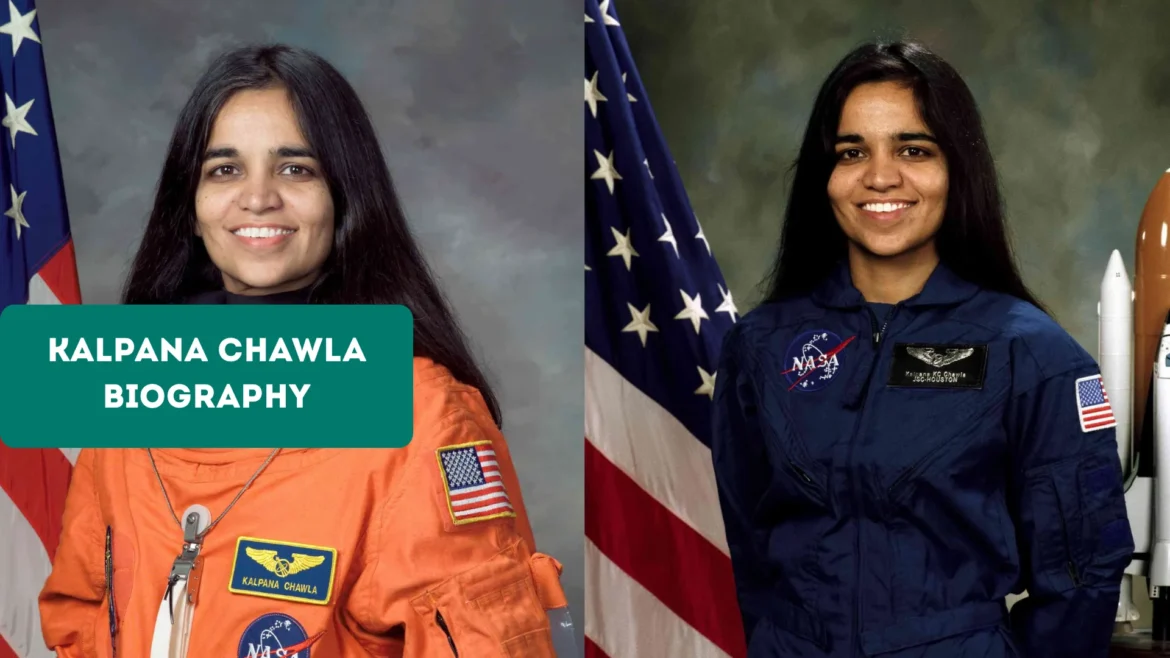
Kalpana Chawla remains one of the most inspiring figures in the history of space exploration.
Born in a small town in India, she rose to global prominence by becoming the first Indian-born woman to travel into space. Her life story is a testament to determination, curiosity, and the power of dreaming beyond boundaries.
Kalpana Chawla’s journey from Karnal, Haryana, to the vastness of outer space continues to motivate millions of students, scientists, and dreamers across the world. This detailed Kalpana Chawla biography covers her early life, education, NASA career, space missions, achievements, tragic death, and enduring legacy.
Early Life
Kalpana Chawla was born on March 17, 1962, in Karnal, Haryana, India. From a young age, she displayed a deep fascination with airplanes and the sky. Growing up near local flying clubs, she would often watch aircraft soar overhead, sparking a lifelong passion for flight and aerospace engineering.
Despite societal norms at the time, Kalpana was determined to pursue a career in science and aviation. Her parents supported her education, encouraging her curiosity and ambition. This early encouragement played a vital role in shaping her future.
Education and Academic Excellence
Kalpana Chawla’s academic journey reflects her dedication and brilliance:
- Schooling: Tagore Bal Niketan Senior Secondary School, Karnal
- Bachelor’s Degree: Aeronautical Engineering from Punjab Engineering College, Chandigarh
- Master’s Degree: Aerospace Engineering from the University of Texas at Arlington
- PhD: Aerospace Engineering from the University of Colorado Boulder
Her decision to study aerospace engineering at a time when very few women pursued the field highlights her courage and vision. She excelled academically and gained expertise in flight dynamics, computational fluid dynamics, and aerospace systems.
Journey to NASA
After completing her PhD, Kalpana Chawla joined NASA in 1988 as a research scientist at Ames Research Center. She worked on complex projects involving aircraft aerodynamics and simulation.
In 1994, her lifelong dream took a major step forward when she was selected as an astronaut candidate by NASA. After rigorous training, she officially became an astronaut in 1995, marking a historic moment for India and women in science worldwide.
Space Missions and Achievements
STS-87 Mission (1997)
Kalpana Chawla made her first journey into space aboard Space Shuttle Columbia in November 1997 as part of the STS-87 mission. During this mission, she served as a mission specialist and robotic arm operator.
Key highlights of STS-87:
- Spent nearly 16 days in space
- Conducted microgravity experiments
- Operated the shuttle’s robotic arm
- Contributed to scientific research in space technology
This mission established her as a skilled astronaut and role model on the global stage.
STS-107 Mission (2003)
Her second spaceflight, STS-107, was a dedicated science mission focused on microgravity research. The crew conducted more than 80 experiments across biology, physics, and material science.
Tragically, on February 1, 2003, Space Shuttle Columbia disintegrated during re-entry into Earth’s atmosphere, leading to the loss of all seven crew members, including Kalpana Chawla.
Tragic Death and Global Mourning
The Columbia disaster shocked the world. Kalpana Chawla’s untimely death at the age of 40 was mourned globally. Governments, space agencies, educational institutions, and individuals paid tribute to her extraordinary life and contributions.
India, in particular, honored her as a national hero. Vigils, memorials, and scholarships were established in her name, ensuring that her legacy would live on.
Awards
Kalpana Chawla received numerous honors posthumously, including:
- Congressional Space Medal of Honor (USA)
- NASA Space Flight Medal
- NASA Distinguished Service Medal
-
Asteroids, satellites, and educational institutions named in her honor
These recognitions celebrate her contributions to science and her role in inspiring future generations.
Legacy and Inspiration
Kalpana Chawla’s legacy goes far beyond her achievements in space. She became a symbol of hope for young girls aspiring to enter STEM fields. Her famous words continue to inspire:
“The path from dreams to success does exist. May you have the vision to find it, the courage to get onto it, and the perseverance to follow it.”
Scholarships, science programs, and space research initiatives around the world continue to bear her name, encouraging students to dream big.
Frequently Asked Questions (FAQs)
Who was Kalpana Chawla?
Kalpana Chawla was an Indian-born American astronaut and aerospace engineer who became the first Indian-born woman in space.
When was Kalpana Chawla born?
She was born on March 17, 1962, in Karnal, Haryana, India.
How many space missions did Kalpana Chawla fly?
She flew two space missions: STS-87 in 1997 and STS-107 in 2003.
What happened to Kalpana Chawla?
She died in the Space Shuttle Columbia disaster on February 1, 2003, during re-entry into Earth’s atmosphere.
Why is Kalpana Chawla famous?
She is famous for being the first Indian-born woman in space and for her contributions to space science and inspiration to millions.
Conclusion
Kalpana Chawla’s life story is one of courage, ambition, and unwavering belief in dreams. From a small town in India to the infinite expanse of space, her journey proves that with hard work and determination, no dream is too big. Her legacy continues to inspire generations to look up at the stars and believe in the impossible.