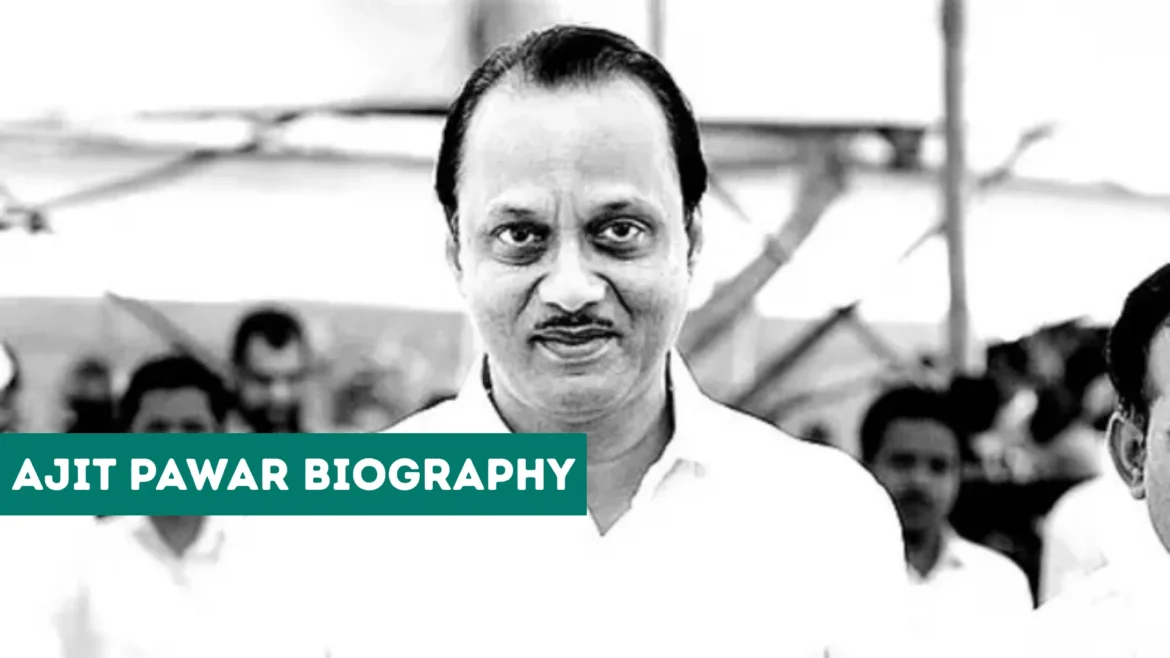
Few politicians in Maharashtra have been as durable and influential at the state level as Ajit Pawar. Born into a politically active family and rising through the cooperative movement, he became a kingmaker in state coalitions, repeatedly holding senior ministerial posts and playing an outsized role in irrigation, finance, and rural development policy.
Profile Data
| Full Name | Ajit Anantrao Pawar |
| Born | 22 July 1959 |
| Age | 66 years (as of 2025) |
| Birthplace | Deolali Pravara, Ahmednagar district, Maharashtra, India |
| Nationality | Indian |
| Occupation | Politician |
| Parents | Anantrao Pawar (Father), Ashatai Pawar (Mother) |
| Spouse | Sunetra Pawar |
| Children | Parth Pawar |
| Relationship | Married |
| Net Worth | Estimated in tens of crores of Indian rupees (as per election affidavits) |
Early life
Ajit Anantrao Pawar was born on 22 July 1959 in Deolali Pravara in Ahmednagar district. He entered public life through cooperative institutions — a common route for many Maharashtra politicians — which gave him ground-level influence among farmers, sugar cooperatives and district-level politics. His early leadership in cooperative banks and sugar cooperatives built the network that would later translate into electoral strength in Baramati and nearby areas.
Political ascent — local to state leadership
- 1980s–1990s: Ajit Pawar built influence in cooperative banks and sugar factories, political institutions that in rural Maharashtra are power bases. He first consolidated control locally and then entered electoral politics.
- 1991 onward: He was elected from Baramati (a Pawar family stronghold) and went on to hold multiple legislative terms and posts. Over the next three decades he served multiple stints as Deputy Chief Minister and held major portfolios like Irrigation and Finance in various state cabinets.
Major portfolios and policy focus
Ajit Pawar’s political identity is closely linked to two public policy areas:
- Irrigation and rural infrastructure: He championed large irrigation projects and was closely associated with water management programs aimed at benefiting the agrarian constituencies that sustained his political base.
- Finance and budgetary oversight: In roles such as Finance Minister (or holding the finance portfolio within coalition arrangements), he managed fiscal priorities for Maharashtra, influencing allocations for rural development and cooperative sectors.
His governance style combined administrative decisiveness with deep local patronage, which helped keep his electoral base intact across political upheavals.
The 2023–2024 political upheaval (brief chronology & significance)
Maharashtra politics in 2022–2024 saw major turbulence: coalition realignments, a surprise rebellion in 2022, and changing alliances. Ajit Pawar played a dramatic role in this era — at times as the opposition leader, at other times as a crucial coalition partner — reflecting both his adaptability and the fractured nature of state politics. Analysts widely credit him as one of the state’s main power brokers during this period. (See detailed reporting and timeline in linked sources.)
Controversies and legal scrutiny
Like many long-serving leaders, Ajit Pawar faced allegations and controversies tied to:
- Procurement and project administration (notably in irrigation project contracts),
- Cooperative bank governance and related financial questions, and
- Intricate intra-party disputes and splits that sometimes involved defections or factional fights.
Some controversies led to media scrutiny and legal inquiries; others remained in the arena of political argument. Election affidavits and investigative reporting provide the public record for financial holdings and pending litigations (where applicable).
Electoral record & constituency work
Ajit Pawar’s success in Baramati and neighboring areas was built on decades of constituency work, visible infrastructure investments, cooperative linkages, and effective voter mobilization. He won multiple legislative terms and, over the years, adapted his strategies to shifting party alliances while retaining a strong local base.
Finance, assets and net worth — what public records say
Election affidavits are the primary source for declared assets. Independent reporting aggregates these declarations and estimates net worth: some mainstream reports cite declared assets in the tens of crores with differing totals depending on year and valuation method. Financial portfolios typically included immovable property, bank deposits, investments, vehicles and cooperative holdings. For specifics, see affidavits archived on public portals and the consolidated reporting by major outlets.
Family, personal life and political dynasty linkages
Ajit Pawar belonged to the extended Pawar political family — long influential in Maharashtra. The family’s political reach spans cooperative institutions, electoral seats and organizational leadership. Family ties have both helped and complicated his political journey.
Notably, his relationship to senior leader Sharad Pawar (uncle) placed Ajit Pawar at the heart of intra-party dynamics and public scrutiny. This family connection repeatedly shaped both support and factional tensions within the broader Nationalist Congress Party framework.
Death, immediate aftermath and political consequences (January 2026)
On 28 January 2026, Ajit Pawar died after the aircraft he was traveling in crash-landed near Baramati. The incident prompted an outpouring of tributes across political lines and immediate questions about succession in party and government roles. News outlets and official statements covered the search, rescue and subsequent political developments.
The event also triggered immediate internal discussions within the party about leadership, legislative representation, and continuity in ongoing projects and portfolios. Media coverage and official party responses provide the evolving picture.
FAQs
Q1: When was Ajit Pawar born and when did he die?
A: Born 22 July 1959; he died on 28 January 2026.
Q2: What major positions did Ajit Pawar hold?
A: Multiple terms as Maharashtra Deputy Chief Minister, several state minister portfolios including Finance and Irrigation, and long-standing MLA representation for the Baramati region.
Q3: What was Ajit Pawar’s net worth?
A: Public affidavits and media aggregation place his assets in the multi-crore range; recent reporting quoted figures varying by source (see Economic Times, Moneycontrol, and affidavits for specific itemized values).
Q4: Was Ajit Pawar involved in major controversies?
A: Yes — controversies surrounded irrigation projects, cooperative banking governance, and intra-party factionalism. Many issues were covered in media reports and public records.
Q5: Who are the major family members and political relations?
A: He was part of the Pawar family; his uncle is Sharad Pawar. His family’s active role in politics and public life is widely documented.
Conclusion
Ajit Pawar’s political story is both a personal biography and a window into Maharashtra’s modern politics: the centrality of cooperative institutions, the importance of local constituency networks, the mechanics of coalition building, and how political durability is built and tested. His rise, influence and the controversies that accompanied him reflect broader themes in sub-national Indian politics. The events around his death in January 2026 also underline how sudden developments reshape political calculations and leadership succession in real time.